


Table of Contents
- Introduction to Garage-to-ADU Conversion
- Timeline: How Long the Process Takes
- Budgeting for Your ADU Project
- Financing Options for Garage ADUs
- Design and Planning Your ADU
- Obtaining and Processing Permits
- Property Value & Tax Considerations
- Dreamhomedesign & Build
- Conclusion
- FAQ’s
Introduction to Garage-to-ADU Conversion
The transformation of a garage into an accessory dwelling unit (ADU) is turning out to be one of the most widespread methods to maximize property value and establish a new living space. Garage-to-ADU conversion enables homeowners to convert underutilized spaces into modern functional homes, guest suites, or rentals. The current trend of ADU construction is driven by the increasing housing needs, rising property values, and the flexibility that ADUs offer with regard to the issue of multigenerational living. Transforming a garage, the homeowners not only maximize the space but also create an earning or practical area that would meet the current living standards.
The adu house plans or modern adu plans are some of the plans that many homeowners are seeking to know how to come up with an adu house that is stylish, functional, and yet does not violate the local building rules.
Key points:
- A garage conversion will provide an additional living room or rental income. It also adds value to the property.
- The projects range from 4 to 8 months. The size, design, and permits are time-dependent.
- The conversion costs are between $90,000 and $120,000. This involves construction, permits, and utility upgrades.
- Homeowners have access to home equity mortgages, ADU mortgages, or local grants.
- Good design will mean that it is in accordance with the local rules. Licenses avoid wastage of time and lawsuits.
Timeline: How Long the Process Takes
A certain question that homeowners pose is to find out “How long does it take to turn a garage into an ADU?” The extra time can be taken based on the size of the garage, local permit provision, and the design complexity. On average, a garage conversion project may require four to eight months to start and finish.
The process begins with planning and design, acquisition of relevant adu permits, building, and concluding inspections. The projects that involve fewer structural changes and are less complex might be completed in less time, whereas those that involve a major change in utility needs or structure might prolong the project. People who plan their home improvement projects in advance and engage professional contractors are likely to have a smoother and quicker project completion.
Budgeting for Your ADU Project
To prevent unforeseen costs, it is essential to budget for the conversion of a garage to an ADU.

The question that is often asked by homeowners is, “How much will a garage conversion cost in 2026?” The average is between $90,000 and $120,000, and this will vary according to location, design, materials, and the scale of construction.
Construction Cost for ADU
Construction is the primary part of your budget. This incorporates framing, insulation, flooring, plumbing, electrical, and interior finishes. The customized modern adu plans and high-quality materials can raise costs, but also could bring long-term value and attractiveness. The labor costs are also dependent on the regions and the experience of the contractor. The estimated cost of an ADU typically ranges from $90,000 to $350,000, depending on size, design, and basic construction needs.
Permits and Fees
The process of obtaining permits is a prerequisite for construction in the ADU. The adu permit process generally consisted of building permits, planning approvals, and occasionally environmental reviews. The permit charges are not fixed, but they may take several thousand dollars. Failure to obtain the required permits may attract fines and legal troubles.
Utility Upgrades
The transformation of a garage into a residential area is prone to utility upgrading. The installation of new plumbing, electrical, HVAC, and the correct insulation may be an expensive thing. This is very critical when your garage was not initially linked to the main utilities. The preparations made for such upgrades avoid delays at the time of construction.
Financing Options for Garage ADUs
Many homeowners consider financing such projects in order to complete their garage-to-ADU projects. There are various techniques to be used based on the financial status and the objectives of a project.
Home Equity Loans
ADU construction is mostly based on home equity loans. You can borrow money at low-interest rates by pledging your house as security for the loan, which is better than borrowing money through personal loans. These mortgages are also ideal for those homeowners who want to add value to their property as they fund the construction.
ADU construction loans :
They are mostly based on home equity loans. You can borrow money at low-interest rates by pledging your house as security for the loan, which is better than borrowing money through personal loans. These mortgages are also ideal for those homeowners who want to add value to their property as they fund the construction.
Local Grants and Incentives
Certain states and cities provide incentives, grants, or low-interest loans to facilitate ADU construction. These programs will make houses more affordable and offer financial assistance to homeowners. Local programs are also important, and in this case, they can help save a lot of money on your project.
Design and Planning Your ADU
Planning and designing are essential in the development of an ADU that will suit you and does not break the rules. To maximize space, light, and functionality, begin by investigating ADU house plans or modern ADU plans. Use designers or architects who are knowledgeable in ADU construction to have your ADU in line with your property and zoning rules.
ADU Requirements
The local governments usually impose requirements on ADU size, height, setback, and occupancy. Early knowledge of such requirements will avoid expensive redesigns. The majority of ADUs must have individual access, sufficient fire control, and proper connections to utilities. The knowledge of the rules does not slow the adu permit process as well.
Obtaining and Processing Permits:
Permission regulations include the filing of the project plans, fee payments, and organization of inspections. The delay is minimized by having a professional who knows the requirements of the permit. The right documentation guarantees that the local building codes and zoning laws are adhered to.
Permit Application Steps:
It would be a good idea to ensure that the construction of an ADU is legal and safe, which is only possible with the help of obtaining permits. The steps of the process are typically the following:
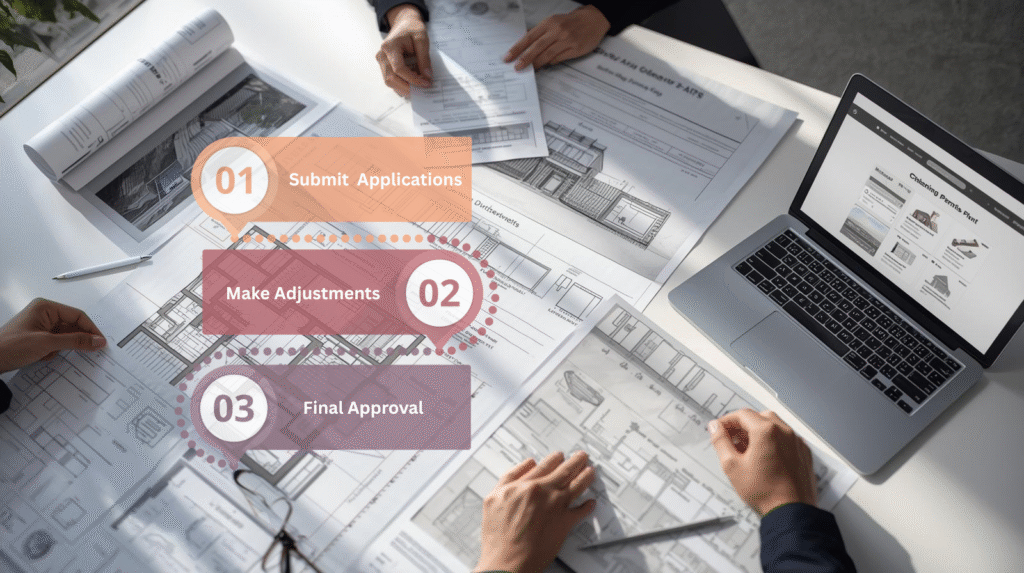
Get Your Documents:
Start by preparing all the documents required, like property surveys, construction plans, utility plans, and structural assessments. Proper documentation eliminates redundant amendments.
Submit Your Permit Applications:
Application to the local building/planning department. All the necessary forms, fees, and construction drawings should be included in the applications. Other cities have online submissions; hence are faster processed.
Make Adjustments:
Upon inspection, government officials might ask you to realign your plans to suit the local codes. Deal with such changes early enough to prevent project delays.
Final Approval:
After determining that your plans are fit to meet the requirements, you are given final approval. Construction is possible at this stage. Regular checks are performed to make sure that the work is based on accepted plans.
Property Value & Tax Considerations:
A garage can be converted to an ADU, and this will add value to your property in terms of space or potential rent.
The question that homeowners have is, “Will converting a garage raise property taxes?” The assessed property value is raised in most instances by the inclusion of an ADU, which can have a minor impact on the property tax. The tax impact, however, is generally offset by the long-term gains, such as rental income and higher resale value. When this is planned properly, the tax implications are manageable.
Dreamhomedesign & Build
Dreamhomadesignandbuild provides the best services of ADU design, all the way to construction management, to homeowners in need of professional advice. 
They are experts in developing concepts into effective projects of accessory dwelling units construction. The experience they have gained will see your garage conversion not only interesting to look at, but also to meet the local rules and be within budget and time limits. Visit our recent successful ADU projects.
Conclusion
The best thing to do with a garage is to transform it into an ADU, where it gains the maximum property value, provides more living space, and generates rental income. It is important to know when the project will be finalized, the cost, financing alternatives, design, permit procedure, and any tax benefits of the project to ensure the project is completed successfully. The required preparation, studying the ADU house plans, obtaining a loan, and going through the permits, also allows homeowners to avoid the typical pitfalls and have the full benefits of their new ADU. A garage-to-ADU conversion is a good investment in the future, whether it is because of family needs or rental income.
Frequently Ask Question
Can every garage be converted into an ADU?
Not all garages can be converted. Factors such as size, structural condition, zoning regulations, and utility access affect feasibility. A professional assessment is recommended before planning.
Do all cities allow garage conversions?
No, local laws and zoning codes are not the same. Certain cities promote the construction of ADUs, and others do not. The first one is to always look at the local regulations before embarking on a project.
How long does the permit approval usually take?
The time taken to permit the area differs according to the city and the complexity of the project. It is usually between several weeks and months. Delays are minimized by proper documentation and compliance.
Can you sleep in a converted garage?
Yes, assuming that the ADU complies with the local building codes of habitable space, such as good insulation, ventilation, and safety.
How much does an ADU increase property value?
ADU has great potential in raising property value depending on size, design, and rental potential. It has an average of a 20 percent increase in property value or even greater relative to the local real estate market.